
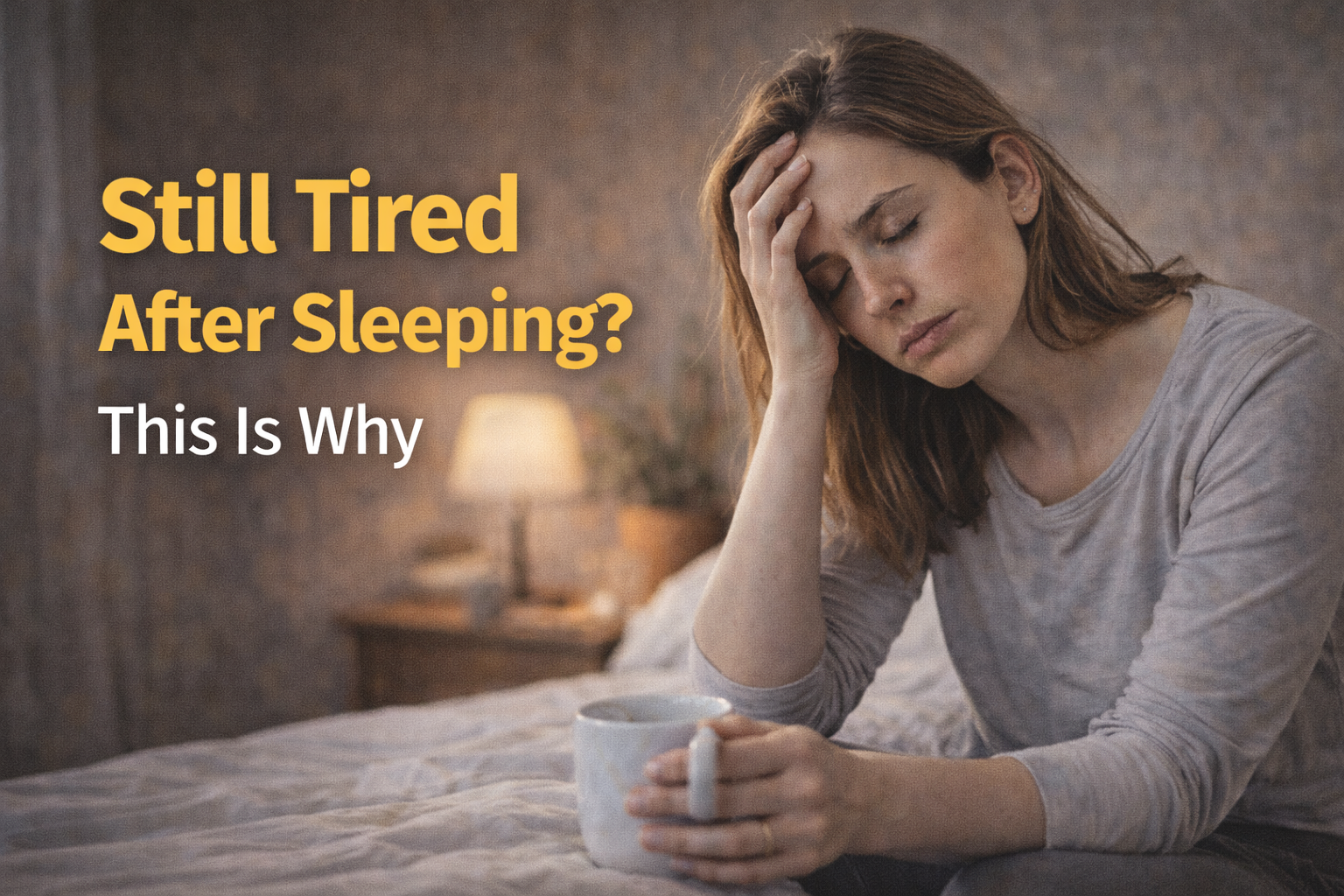
Why Do I Feel Tired Even After Sleeping?
It is one of the most frustrating feelings to wake up after what should have been a full night of sleep and still feel like your body never properly came back online. You open your eyes, sit up, and instead of feeling clear or steady, there is that same heavy feeling sitting in the background. Not dramatic. Not enough to stop your day completely. But enough to make everything feel slower than it should. Enough to make small tasks feel slightly annoying before the day has even properly started. That is exactly why so many people search things like why do I feel tired even after sleeping or why am I tired after sleeping, because on the surface it makes no sense. If sleep is supposed to restore energy, why does your body still feel drained afterward?
The answer, in most cases, is that sleep and recovery are not exactly the same thing. A person can sleep for seven, eight, or even nine hours and still wake up tired if the body never moved through the kind of deeper restoration it needed. This is where many people get stuck. They count hours, assume the problem must be elsewhere, and keep pushing through the same pattern. But the body does not care about the number on the clock as much as it cares about the quality of rest, the amount of stress still active in the system, the stability of your routine, and whether your brain actually got the chance to settle down.
And that is what makes this topic more important than it looks. Feeling tired after sleeping is rarely just about one bad night. It is often a clue. A quiet one, yes, but still a clue. It usually means something about your recovery process is incomplete, inconsistent, or being interrupted in ways you do not fully notice yet.
1. You slept, but your body did not recover deeply
This is where the misunderstanding usually begins. People often think sleep works like charging a phone. Put the body down for enough hours and it should return to full energy by morning. Real life is messier than that. Sleep only becomes truly restorative when the brain and body move through enough deep, uninterrupted recovery. If that process is delayed, fragmented, or too light, you may wake up technically rested on paper but not functionally restored in real life.
That is why someone can spend eight hours in bed and still feel like their energy is strangely unfinished. The body may have paused, but it did not fully repair, regulate, and reset. This becomes even more obvious in people who regularly say they are tired after sleeping even though they went to bed on time. It is not always a matter of sleeping longer. Sometimes it is simply that the sleep you are getting is not doing the job you think it is doing. This links closely with why do I feel tired even after sleeping 8 hours, because a full night of sleep does not automatically equal a full night of recovery.
2. Your brain may still be carrying the day into the night
A lot of tiredness that shows up in the morning really started the evening before. Not because something dramatic happened, but because your brain never truly stepped out of response mode. It kept processing, reacting, replaying, checking, switching, and staying lightly engaged even when your body was already trying to slow down.
This is common now because the average evening is full of input. Messages, videos, scrolling, tabs, half-finished conversations, leftover work thoughts, random searching, short-form content, background noise. None of it looks intense on its own, but taken together it keeps your nervous system from fully settling. So when you fall asleep, your mind is not entering sleep from a calm baseline. It is entering sleep from a stimulated one.
That difference matters. It means your body may sleep, but your brain does not always drop into the kind of quiet, deeper rest that helps you wake up clear. This is one reason tiredness and brain fog so often appear together. If you have noticed that your mind feels cloudy in the morning, not just sleepy, it also connects naturally with mental cloudiness explained, where mental load slowly reduces clarity even when nothing “major” seems wrong.
3. Your mornings may be extending the fatigue instead of breaking it
Some people wake up tired because their sleep was poor. Others wake up slightly tired and then accidentally make it worse. The first hour of the day matters more than most people realize because it either helps your system shift into alertness or keeps you stuck in a slow, half-awake state for longer.
This usually happens through small habits that feel harmless. Staying in bed too long after waking. Checking your phone immediately. Starting the day passively instead of physically. Avoiding daylight. Delaying food or water for too long. It does not feel serious in the moment, but it sends weak signals to a body that is already struggling to feel awake. Instead of helping your energy rise, these habits stretch the tiredness across the morning.
That is part of why some people say, “I only feel normal by afternoon.” The problem is not always that sleep failed completely. Sometimes it is that the transition into wakefulness was too weak. This is exactly why why do I wake up tired every morning matters as an internal link here, because the tiredness after sleep and the tiredness on waking are deeply connected. And in many cases, the patterns also reflect Morning Mistakes Most People Make, where a slow, reactive start can quietly flatten the rest of the day.
4. Your sleep may be interrupted in ways you do not remember
One of the reasons people get confused by low energy after sleep is that they only count the interruptions they remember. But sleep can be affected by a lot of smaller disturbances that never fully wake you up in a memorable way. Light leaking into the room. A noisy environment. A room that is too warm. Physical discomfort. Restlessness. Waking briefly and rolling over. Even subtle shifts like these can pull the brain out of deeper stages of sleep without creating a clear memory of it.
This is what makes poor sleep quality tricky. From the outside, it can look like you slept all night. From the inside, your recovery may have been broken into shallower pieces. You may not remember the interruptions, but your nervous system does. And when that happens repeatedly, the next morning often arrives with low energy, slower thinking, and the sense that your sleep did not really “work.”
For many people, this becomes a repeating cycle. They do not realize sleep is being interrupted, so they keep searching elsewhere for the cause. Meanwhile, the body continues waking up under-restored day after day.
5. You are waking up slightly dehydrated and underpowered
This cause is simple, but it gets overlooked because it sounds too small to matter. During sleep, your body loses fluid. You wake up slightly dehydrated by default. If the first part of your morning includes no water, little movement, and only caffeine, you can end up magnifying that low-energy feeling instead of improving it.
Hydration affects circulation, concentration, and how quickly the body feels physically “online.” If the brain is not getting what it needs early in the day, tiredness lingers. And because the feeling is gradual rather than dramatic, people often do not notice that dehydration is part of the problem. They just describe the result: low energy after sleep, slow thinking, heaviness in the head, and that dull, behind-the-eyes fatigue that makes the morning feel foggy.
This is also one reason brain fog after sleep and morning fatigue causes overlap so often. The body does not start the day from a neutral state. It starts from whatever conditions you gave it overnight and whatever support you give it next.
6. Blood sugar instability can make the tiredness feel worse
Sometimes what people describe as tiredness after sleep is partly unstable energy rather than pure exhaustion. If you wake up after a long gap without food, then either delay eating too long or eat something that causes a fast rise and crash in blood sugar, the morning can feel mentally and physically off very quickly. The body may not be sleepy in the classic sense, but it can feel weak, unsteady, irritable, or mentally slow.
This is one of those causes that people tend to underestimate because it does not sound dramatic enough. But a body with inconsistent fuel often feels tired even when sleep time was decent. The brain likes stability. When it does not get that, mental performance falls, and people often mistake that drop for random fatigue.
That is why the question is not only, “Did I sleep?” It is also, “What condition did I wake up into?” Recovery is not just what happens at night. It is also what supports the body once morning begins.
7. Stress may be present even if you do not call it stress
A lot of people say they are not particularly stressed and still feel constantly tired. In many cases, that is because they are imagining stress as something loud and obvious. Panic. Anxiety. Pressure. Overwhelm. But stress also has a quieter version. It can sound like background concern. It can look like unfinished mental tension. It can live inside constant responsibility, low-level uncertainty, or the feeling that your brain never fully powers down because there is always something waiting.
That kind of stress is exhausting because it never fully leaves the system. It shapes how deeply you rest, how quickly you wake, and how much mental energy is available the next day. It can also create mental fatigue symptoms that blur into physical tiredness. You may not say, “I feel stressed.” You may simply say, “I feel tired all the time.” The body often says it first.
This also ties naturally into Why Am I Always Tired Even After Rest, because a person can stop working, take breaks, even lie down—and still feel tired if the mind never really exits that low-level alert state.
8. You are trying to recover in an overstimulated environment
The body does not recover especially well in constant stimulation. That sounds obvious, but modern daily life makes it harder to notice than it should. Many people are living in environments where they are almost always processing something: bright screens, notifications, clutter, constant background media, multiple open tasks, indoor lighting, too much sitting, and too little real downtime.
This affects sleep and it affects what happens after sleep. If your system is rarely quiet, your energy baseline stays lower than it should. You may be sleeping, yes, but not entering the kind of physical and mental stillness that allows full restoration. Then morning arrives and you wonder why the tiredness is still there.
This is one reason fatigue often improves when people add basic things that seem unrelated at first—more daylight, more walking, quieter evenings, less random input. The body works better when the environment stops demanding so much from it.
9. Your body clock may be out of rhythm
Even if you sleep a decent number of hours, irregular timing can still leave you tired. The body responds strongly to rhythm. When bedtime and waking time move around too much, the circadian system loses predictability. That makes it harder for the body to know when to prepare for sleep, when to produce alertness, and when to shift energy naturally across the day.
A person can get “enough” sleep and still feel tired if that sleep is happening at inconsistent times or if the body never develops a stable pattern for recovery. This often shows up in people who try to catch up on sleep, sleep differently on weekdays and weekends, or change their bedtime based on mood, workload, or screens.
The result is frustrating because it feels like the body is not cooperating. In reality, the system may just be lacking a stable rhythm strong enough to support reliable recovery.
10. You may be using stimulation to cover fatigue instead of fixing it
When people feel tired after sleeping, it is very common to immediately reach for something that creates alertness—coffee, sugar, social media, noise, strong content, or simply more activity. These things can help temporarily, which is exactly why the pattern continues. The boost makes you feel like the problem was solved. But the underlying tiredness is often just being masked.
Later in the day, the crash or heaviness returns. Then the same cycle repeats. This is part of why so many people feel like their energy depends entirely on stimulation. The problem is not just that they are tired. It is that they are managing tiredness in a way that hides the real issue long enough for it to continue.
Steady recovery feels different from stimulated alertness. One is quieter, but more durable. The other is louder, but temporary.
11. Sometimes your tiredness is the body asking for a closer look
Most tiredness after sleep comes from routine, recovery quality, mental load, hydration, rhythm, and daily habits. But it is still important to say this clearly: if your fatigue is persistent, worsening, or paired with other symptoms that concern you, it is worth discussing with a qualified medical professional. Feeling tired after sleeping does not automatically mean something serious is wrong, but ongoing unexplained fatigue also should not be brushed aside forever.
The point is not to become anxious. It is to stay honest. If you have already improved the basics and still feel consistently drained, getting checked is a sensible step.
What usually helps first
The people who improve this kind of tiredness most often are usually the ones who stop looking for one dramatic fix and start correcting the smaller patterns that quietly flatten energy every day. Better evening wind-down. Less screen stimulation late at night. More daylight in the morning. More water earlier. More movement. Less fragmented attention. More stable food timing. Fewer reactive starts to the day.
None of this sounds flashy. That is exactly why so many people ignore it. But the body tends to respond more strongly to repeated basics than to occasional extremes.
If you are still asking why do I feel tired even after sleeping, the answer is often not hidden inside one major mystery. More often, it is hiding in plain sight—in how you sleep, how you wake, how you fuel yourself, how much stimulation you carry, and whether your body ever truly gets the chance to recover.
Final thoughts
The frustrating part about feeling tired after sleep is that it makes you doubt your own routine. You did the thing that was supposed to help. You slept. And still, the body feels behind. But tiredness like this usually has a structure. It is not random. It has clues. It has patterns. It has habits attached to it.
Maybe your sleep is lighter than you realize. Maybe your brain stays active too long. Maybe your mornings are too passive. Maybe your fuel, hydration, and rhythm are weaker than they should be. Maybe the tiredness is partly physical and partly mental, which is why it has been so hard to pin down.
Whatever the exact mix is, the important part is this: tired after sleeping does not have to stay mysterious forever. Once you start understanding what is shaping your recovery, the feeling becomes much easier to work with—and much easier to change.

Leave a Reply