
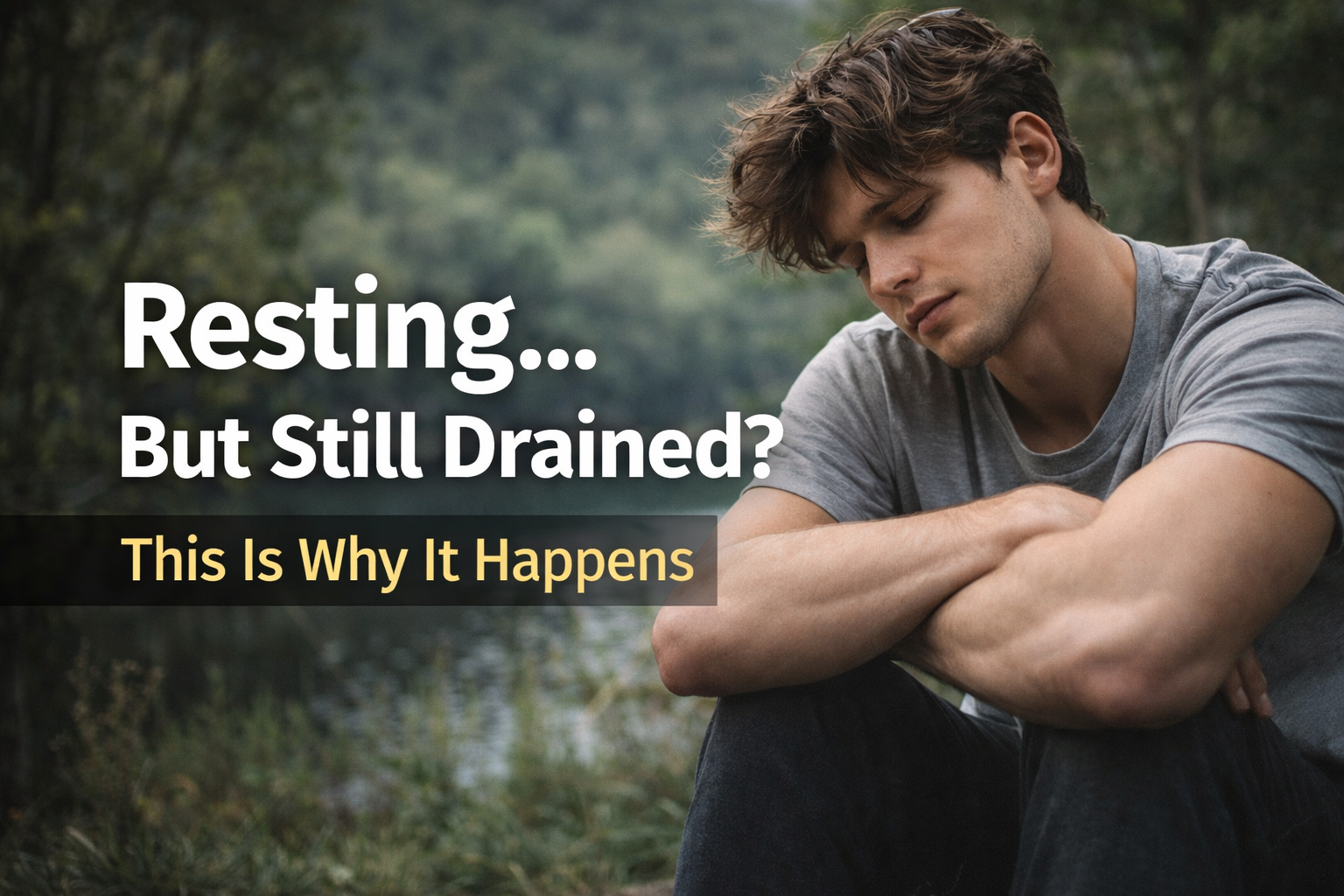
You’re Doing Everything “Right”… So Why Do You Still Feel Off?

It’s confusing at first.
You sit down to rest.
You stop working.
You even give yourself “a break.”
And yet… something doesn’t reset.
The tiredness doesn’t fully leave.
It just softens for a while — then comes back.
Not heavy enough to stop you.
But persistent enough to follow you through the day.
That’s where most people get stuck.
Because from the outside, it looks like you are resting.
But internally, something is missing.
The Type of Tiredness That Doesn’t Go Away Easily
This isn’t the kind of fatigue that disappears after a nap.
It’s quieter than that.
It shows up like:
- difficulty starting simple tasks
- needing more time to “get into” things
- feeling slightly disconnected even during work
You might still function normally.
But everything feels like it requires a bit more effort than it should.
This pattern often overlaps with mental cloudiness explained — where clarity drops without a clear reason.
What Most People Get Wrong About Rest
Here’s the mistake:
Most people treat rest as the absence of activity.
So they:
- lie down
- scroll on their phone
- watch something
- sit without moving
And technically, yes — they’re not “working.”
But their mind hasn’t actually stopped engaging.
It just switched to a different form of stimulation.
So instead of recovery…
👉 It becomes distraction disguised as rest.
The Hidden Pattern Behind This
Your brain doesn’t recover just because you paused your tasks.
It recovers when it experiences a true drop in input.
But modern habits do the opposite.
Even during “breaks,” you’re still:
- consuming content
- reacting to information
- switching attention constantly
Which means your system never fully settles.
And when that happens repeatedly…
👉 You stay in a low-level drained state all day.
Why This Keeps Happening to You
It’s not random.
There’s a pattern behind it:
1. You Don’t Fully Disconnect
Even during rest, something is always “on.”
2. Your Attention Keeps Shifting
Small switches add up more than you realize.
3. Your Brain Stays in Response Mode
Instead of slowing down, it keeps reacting.
A Small Observation That Changes Perspective
Think about the last time you felt genuinely refreshed.
Not distracted.
Not entertained.
But actually reset.
It probably didn’t come from scrolling or watching something.
It came from a moment where:
- things were quiet
- your attention wasn’t pulled in different directions
- nothing demanded a response
That’s not a coincidence.
That’s the state your brain uses to recover.
The Difference Between “Time Off” and Real Recovery
These two are not the same.
Time off:
- you stop working
- but stay mentally active
Recovery:
- your system slows down
- input reduces
- attention stabilizes
One gives temporary relief.
The other actually restores energy.
Why You Feel Better… Then Drained Again
You’ve probably noticed this cycle:
- You take a break
- You feel slightly better
- You return to work
- The tiredness comes back quickly
That happens because:
👉 You didn’t fully reset — you only paused.
So your system resumes from where it left off.
The Role of Your Environment (Bigger Than You Think)
Your surroundings quietly shape your mental state.
Noise.
Screens.
Movement.
Clutter.
Even if you don’t consciously notice them…
👉 Your brain is still processing them.
And that processing uses energy.
This connects with natural ways to boost daily energy where environment plays a key role in recovery.
The Shift That Changes Everything
Instead of asking:
❌ “Did I rest?”
Start asking:
✅ “Did my mind actually slow down?”
That single shift changes how you approach breaks.
What Real Rest Actually Looks Like
It’s simpler than people expect.
But also harder — because it feels unfamiliar at first.
Real rest includes:
- stillness without stimulation
- moments without input
- space where nothing is required from you
No constant checking.
No switching.
No reacting.
Just… pause.
Why This Feels Uncomfortable at First
When you remove stimulation, something interesting happens.
Your mind tries to fill the gap.
You might:
- feel slightly restless
- want to reach for your phone
- look for something to do
That discomfort is temporary.
It’s your system adjusting.
The Moment Where Things Start to Shift
If you stay in that quiet state just a bit longer…
Something changes.
Your thoughts slow down.
Your body relaxes deeper.
Your attention stops jumping.
And that’s when recovery actually begins.
A Simple Way to Test This (No Complex Routine Needed)
Next time you take a break:
Don’t pick up your phone.
Don’t switch to something else.
Just sit.
Even 5–10 minutes.
At first, it might feel like nothing is happening.
But that’s exactly the point.
👉 That “nothing” is where your energy rebuilds.
What Most People Get Wrong About Energy
They think energy comes from:
- motivation
- caffeine
- pushing harder
But real energy comes from:
👉 how well you recover between effort
Why Pushing More Makes It Worse
When you’re already slightly drained and you keep pushing…
Your system doesn’t get time to reset.
So fatigue accumulates quietly.
Not instantly noticeable.
But over time, it builds into:
- constant low energy
- reduced focus
- slower thinking
The Cycle You Might Be Stuck In
- Work → slight fatigue
- Break → distraction (not recovery)
- Work again → faster fatigue
- Repeat
Over time, this creates a baseline where:
👉 you never feel fully recharged
Breaking That Cycle
You don’t need a complete lifestyle change.
Start here:
- one proper break a day
- no stimulation
- no switching
Just a clean pause.
That alone can begin to reset your system.
A Thought Worth Keeping
If you feel drained even after resting…
It’s not because you didn’t stop.
It’s because your mind didn’t get the chance to slow down.
And once you notice that…
You start resting differently.
Leave a Reply