
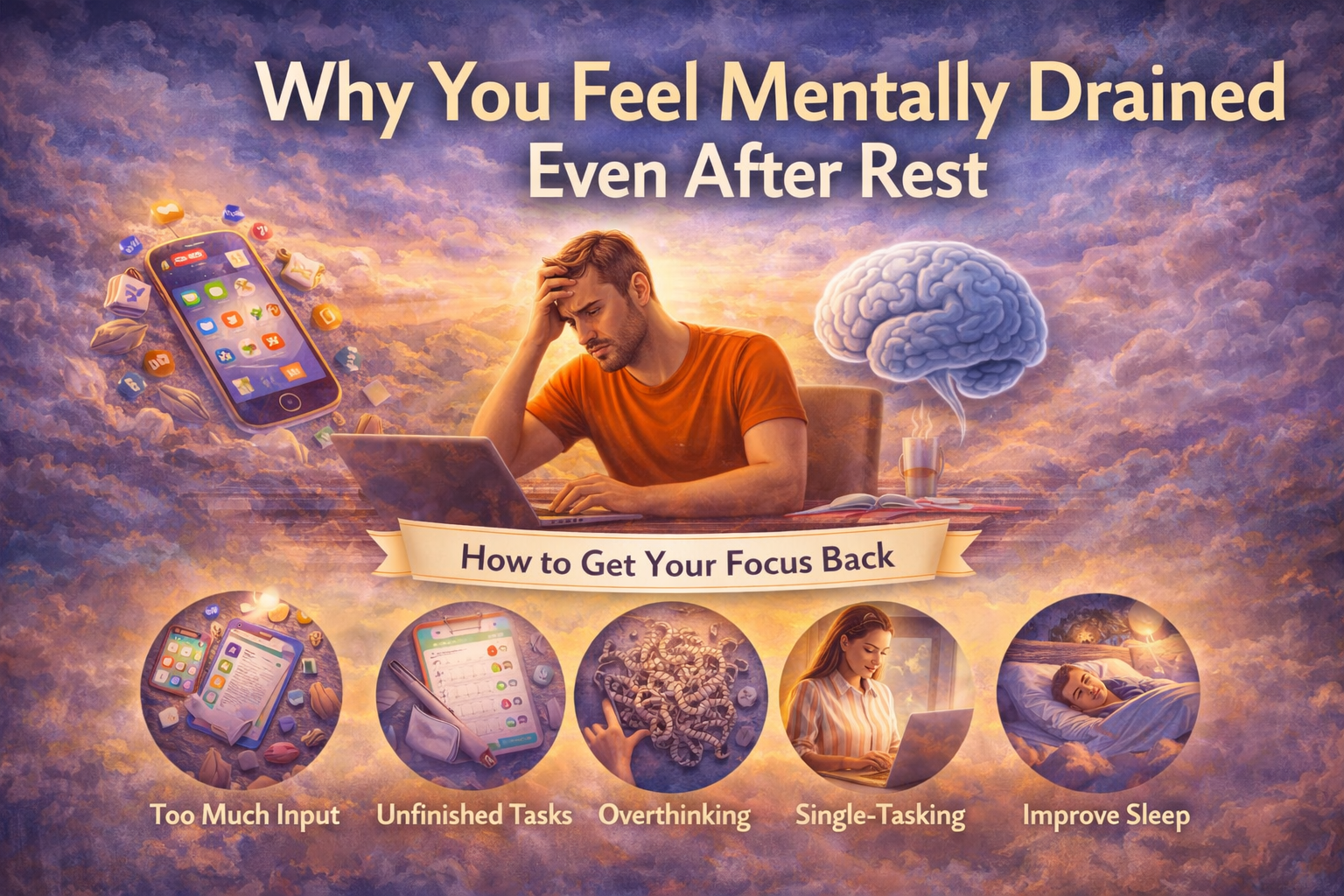

You finally take a break.
Maybe you slept longer than usual.
Maybe you stepped away from work for a while.
But when you return… something still feels off.
Your body might feel okay, yet your mind doesn’t feel fully refreshed.
Simple tasks take longer.
Focus slips more easily than it should.
This can be confusing.
Because rest is supposed to help, right?
The truth is, not all types of rest affect your mind in the same way.
And sometimes, what feels like rest doesn’t actually restore mental energy.
Let’s break down why this happens — and how to fix it in a way that actually works.
1. You Rested Physically, But Not Mentally
There’s a big difference between physical rest and mental recovery.
You might lie down, scroll your phone, or watch something — and technically, your body is resting.
But your brain?
It’s still processing information.
Still reacting.
Still engaged.
That’s why you can finish a long break and still feel mentally tired.
A true mental reset requires reducing input — not just changing activities.
2. Your Brain Didn’t Get Quiet Time
Modern life rarely gives your brain silence.
Even during breaks, there’s:
• music
• videos
• conversations
• notifications
Your brain stays active the entire time.
Without moments of stillness, mental fatigue builds quietly.
This is also one of the key reasons behind mental cloudiness explained constant input prevents clear thinking.
3. You’re Carrying Unfinished Thoughts
Sometimes, mental exhaustion doesn’t come from what you did —
but from what you didn’t finish.
Unresolved tasks stay in the background:
• things you need to do
• decisions you’ve postponed
• conversations you haven’t had
Your brain keeps revisiting them, even during rest.
This makes it harder to feel mentally free.
4. Your Focus Has Been Overused
Focus is like a muscle.
The more you use it without breaks, the weaker it becomes temporarily.
Long periods of concentration without recovery lead to:
• slower thinking
• reduced clarity
• difficulty starting tasks
If your day involves constant thinking, your brain needs intentional recovery — not just passive rest.
5. Your Sleep Isn’t Fully Restorative
Sleeping longer doesn’t always mean sleeping better.
Mental recovery during sleep depends on:
• sleep depth
• consistency
• pre-sleep habits
If your mind stays active before sleep, recovery becomes incomplete.
Many of these patterns come from daily habits, which are explained in Morning Mistakes Most People Make.
6. You’re Switching Tasks Too Frequently
Each shift in activity forces your mind to reorient, which quietly uses up extra energy.
That adjustment requires energy.
If your day involves constant switching:
• work → phone
• phone → work
• task → distraction
…it creates mental fatigue faster than continuous focused work.
This is why fragmented attention feels exhausting.
7. Your Brain Is Dealing With Too Much Input
Your mind isn’t designed to process endless information.
But today, it often tries to:
• absorb content
• respond to messages
• stay updated constantly
Over time, this overload reduces clarity.
It becomes harder to think deeply because your brain is busy handling surface-level input.
8. You’re Not Giving Your Mind Closure
Your brain prefers completion.
When tasks remain open, they continue to consume mental energy.
Even small things — like unfinished emails or pending decisions — can stay active in your thoughts.
Writing things down or organizing tasks helps reduce this mental load.
9. Your Energy Is Being Drained Gradually
Mental fatigue doesn’t happen suddenly.
It builds slowly throughout the day.
At first, it’s barely noticeable:
• slight delay in thinking
• minor distraction
• reduced motivation
But over time, it turns into full mental exhaustion.
These early signals are often overlooked, which is why understanding Hidden Energy Crisis: Signs Your Body Needs Real Rest is so important.
10. You’re Not Matching Work With Energy Levels
Some tasks require more mental effort than others.
If you try to do high-focus work when your energy is low, it feels much harder.
This mismatch creates unnecessary fatigue.
Instead, aligning tasks with your natural energy cycles can improve performance.
Building this awareness starts with a strong Morning Routine That Changes Your Life.
11. You’re Mistaking Distraction for Recovery
Scrolling social media feels like a break.
But in reality, it keeps your brain engaged.
It replaces one form of input with another.
True recovery happens when your brain gets space — not more stimulation.
12. Your Mind Never Fully Switches Off
Even during rest, your thoughts may keep running.
Planning.
Analyzing.
Replaying situations.
This prevents complete recovery.
Learning how to mentally disconnect — even for short periods — can make a significant difference.
How to Actually Restore Mental Energy
Let’s keep it simple and practical.
1. Create Real Mental Breaks
Step away from screens.
Give your mind time without input.
2. Reduce Task Switching
Try to stay with a single task long enough to build real momentum.
3. Write Things Down
Clear your mind by offloading thoughts onto paper.
4. Protect Your Focus Windows
Work in uninterrupted blocks.
5. Improve Sleep Rhythm
Consistency matters more than duration alone.
6. Limit Passive Consumption
Reduce unnecessary scrolling and content intake.
7. Allow Mental Stillness
Spend a few minutes daily without stimulation.
Where Our Understanding of Rest Often Falls Short
Rest is not just about stopping work.
It’s about changing how your brain is being used.
If your brain remains active, reactive, and engaged — it doesn’t fully recover.
Once you understand this, your approach to rest changes completely.
Final Thoughts
Feeling mentally drained after rest can feel confusing.
But it usually has a clear explanation.
Your brain hasn’t had the chance to fully reset.
The solution isn’t more rest — it’s better quality rest.
When you reduce mental overload, allow quiet time, and manage focus properly, clarity starts returning naturally.
And once your mind feels clear again, everything becomes easier — from simple tasks to complex thinking.


Leave a Reply